Developing Research Framework · 6GDT

The Seesaw Effect

A reflection on intelligence asymmetry, systemic interdependence, and the paradox of power in a world where AI, data, and inferential capacity are distributed unevenly.

Proposed conceptual framework and hypothesis · Not a proven theory
Core Idea

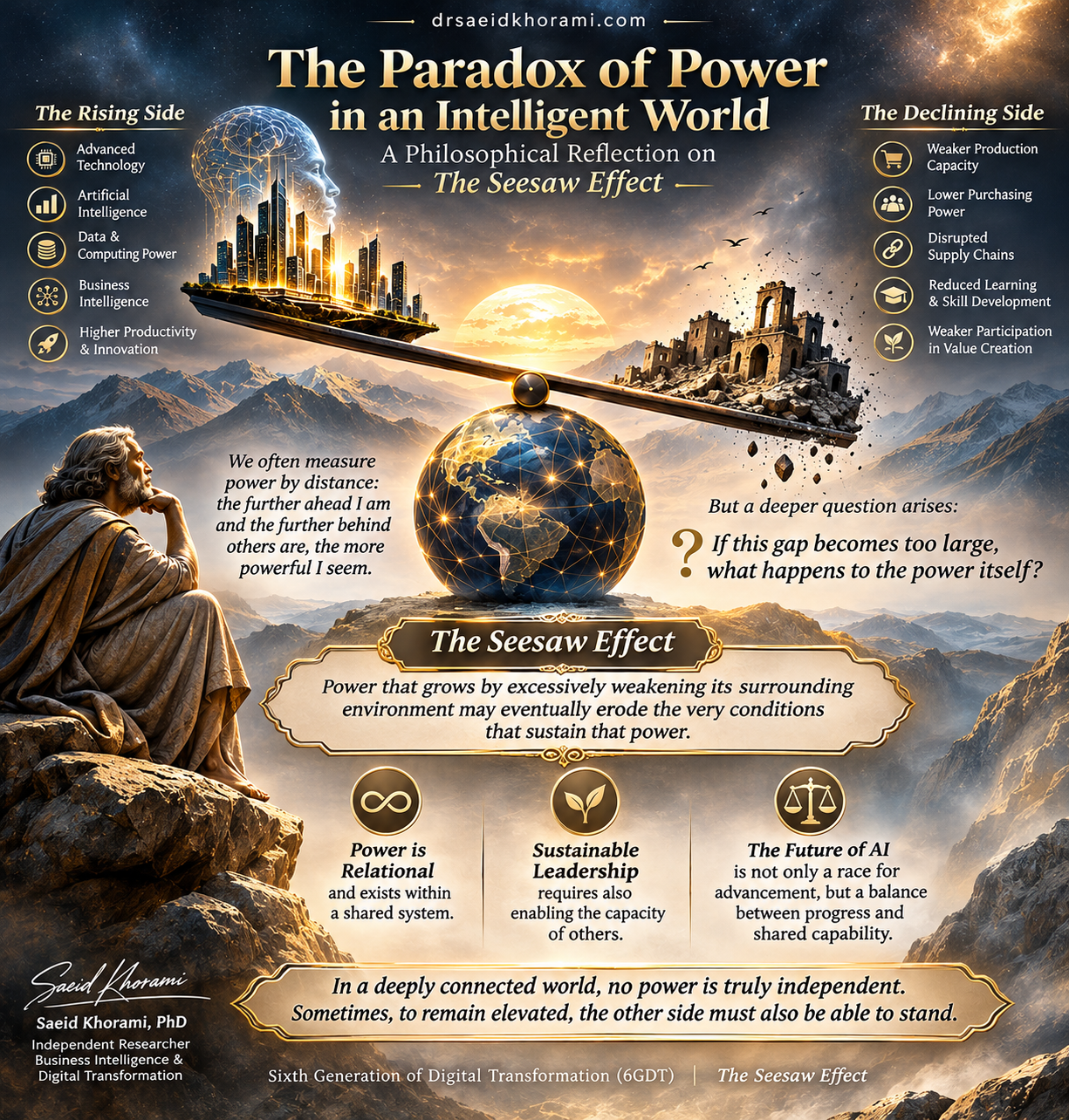
What happens to power itself when the gap becomes too large?

The Seesaw Effect begins with a simple question: can a country or system benefit indefinitely from a widening intelligence advantage while the capacity of other parts of the world to produce, consume, decide, learn, and create value continuously deteriorates?

Power that grows by excessively weakening its surrounding environment may eventually erode the very conditions that sustain that power.
Intelligence concentration→Asymmetry→Participation capacity declines→Systemic feedback→Rebound
From Advantage to Fragility

The gap is no longer merely technological

As AI, compute, data, Business Intelligence, and eventually Inferential Intelligence become concentrated, the divide may become a gap in the ability to understand, anticipate, decide, discover, and create value. Initially, that distance creates advantage. The deeper question is whether it can eventually reduce the capacity of the shared system itself.
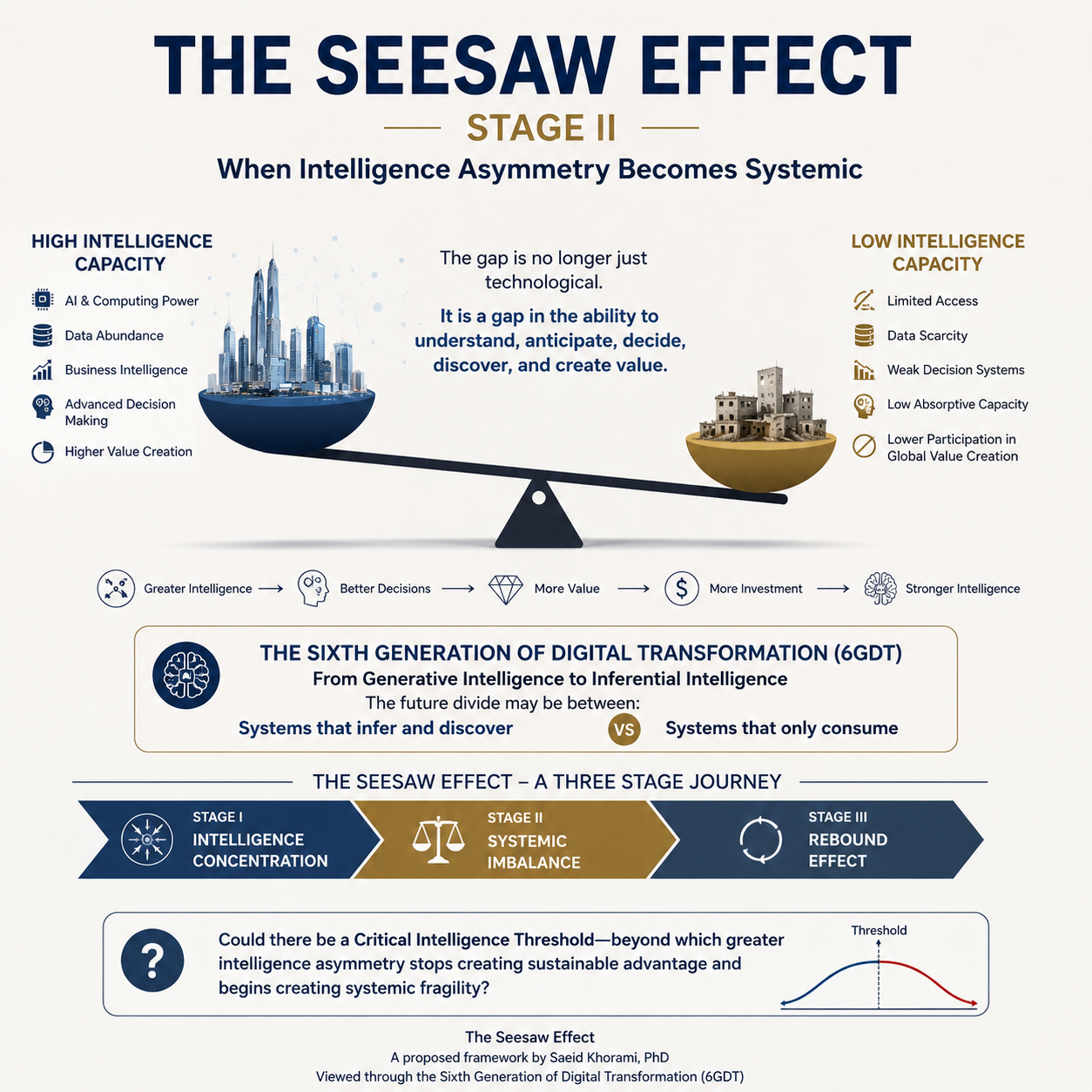
The Seesaw Effect intelligence asymmetry framework
Stage I

Intelligence Concentration

AI, data, compute, and advanced decision capacity concentrate among a limited set of actors.

Stage II

Systemic Imbalance

The divide extends beyond technology into unequal capacity to participate and create value.

Stage III

Rebound Effect

If weakening the other side reduces total system capacity, part of the cost can return to the leaders.

Historical Signal, Not Proof

Lessons from the crises of a new century

The 2009 Global Financial Crisis, the European debt crisis, and the 2020 pandemic had different causes and do not prove the Seesaw Effect. Their relevance is narrower but important: interconnected systems can transmit shocks, amplify them through feedback loops, and return consequences to actors that initially appear stronger.

Lessons from major crises and systemic interdependence
2009

Global Financial Crisis

Transmission from financial disruption into the real economy and global trade.

2012

European Debt Crisis

A visible sovereign–bank–credit–growth feedback loop.

2020

COVID-19 Crisis

Deep interdependence across supply chains, production, demand, and services became visible.

The Paradox of Power

Does sustainable power require a capable “other”?

Advanced economies do not operate in a vacuum. Markets, consumers, supply chains, human capital, knowledge flows, and the participation capacity of others form part of the environment in which advantage is created. If that environment weakens too far, the issue may no longer be inequality alone; the space for value creation itself may contract.

From this perspective, enabling others is not only an ethical proposition. Under some conditions, it may become part of the logic of sustaining power.

The philosophical question

If one side of the world moves so far ahead that the other can no longer participate, does “being ahead” retain the same meaning?

The Paradox of Power in an Intelligent World
Connection to 6GDT

From Generative Intelligence to Inferential Intelligence

Within 6GDT, the issue is not merely unequal access to generative tools. If the capacity to infer, discover hidden relationships, generate hypotheses, and create new knowledge also becomes concentrated, the future divide may increasingly be between systems that infer and discover and systems that primarily consume.

The Seesaw Effect occurs when the systemic cost of intelligence asymmetry exceeds the direct advantage created by that asymmetry.
Research Status

What is observed, interpreted, and still unknown

Evidence

The global economy is networked and interdependent; past crises demonstrate transmission and feedback across connected systems.

Interpretation

Extreme intelligence asymmetry could, in principle, become systemic fragility by reducing participation capacity elsewhere.

Open Hypothesis

There is not yet sufficient empirical evidence to claim that intelligence asymmetry necessarily produces such a rebound. The relationship remains to be tested.

Open question

Can intelligence advantage eventually begin to neutralize itself by weakening the environment on which that advantage depends?