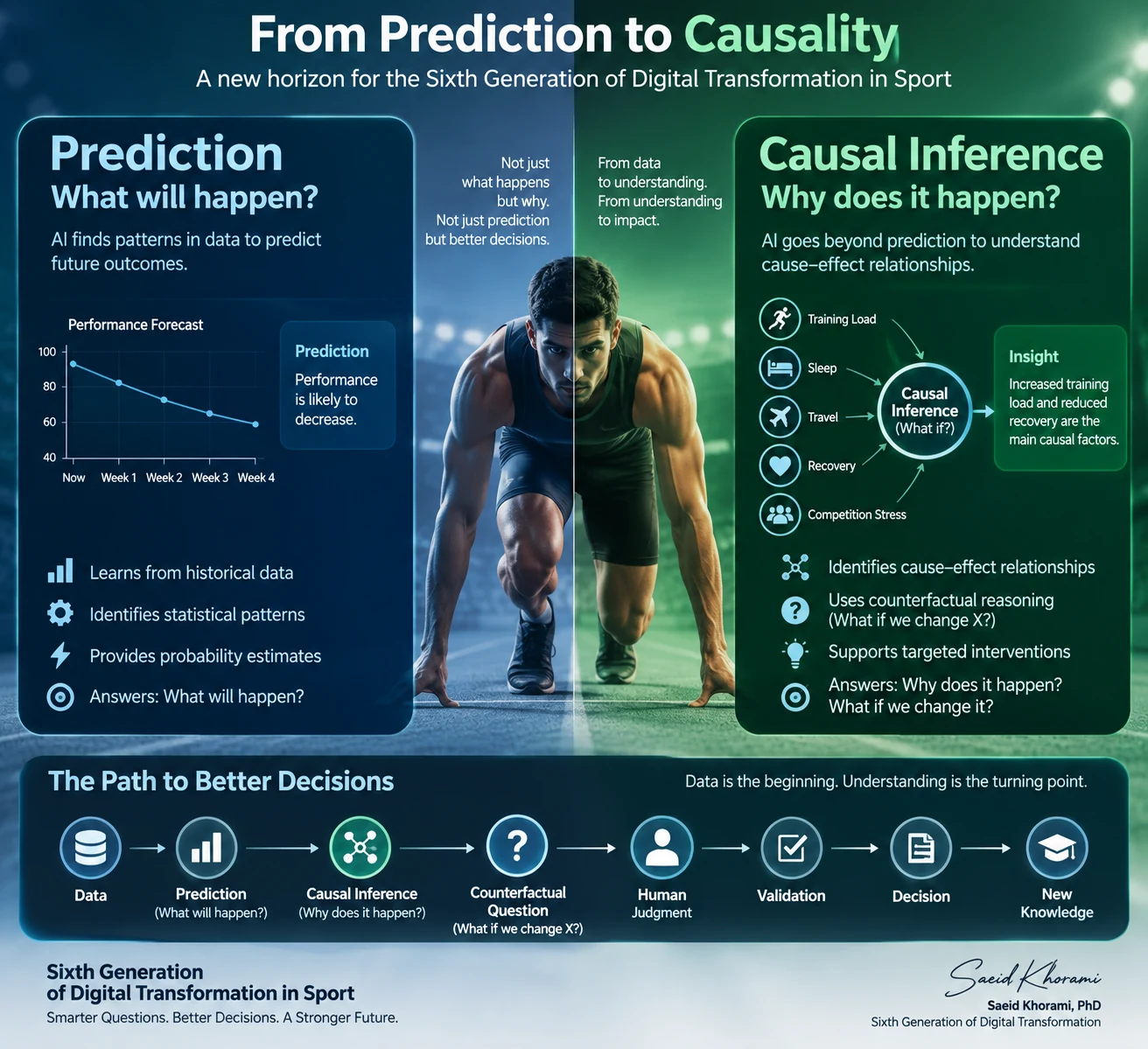
Prediction is useful. It is not the same as explanation.
In sport, AI can already detect patterns, estimate risk and forecast performance. A sixth-generation perspective asks a harder set of questions: why might this outcome be occurring, what would happen under an alternative intervention, and what evidence is strong enough to support action?
Three different capabilities
What is likely to happen?
Patterns · probabilities · forecastsWhy might it be happening?
Mechanisms · confounders · causal hypothesesWhat if we change X?
Alternative actions · interventions · consequencesOperational example
An AI system may predict a decline in athletic performance. Prediction alone does not tell a coach which intervention is appropriate. A causal analysis may investigate whether training load, reduced recovery, sleep, travel or competition stress are contributing factors. A counterfactual question then asks whether changing one of those factors could change the expected outcome.
The proposed 6GDT sport loop
This is a proposed domain application of the Sixth Generation of Digital Transformation. It should be tested empirically rather than treated as an established maturity model.
Why human judgment remains central
Causal language should not be confused with causal proof. Inference depends on data quality, assumptions, study design, domain knowledge and the possibility of unmeasured confounding. In high-stakes sport decisions, AI-generated causal hypotheses should therefore be challenged, validated and interpreted by qualified human experts before action.
Recent research signals
Feng applies causal inference and invariant learning to movement-quality evaluation, explicitly addressing the weakness of models that learn surface correlations and degrade across new dancers or environments.
Shin and Lee frame digital transformation in taekwondo as an integrated physical–digital ecosystem connecting sensing, AI interpretation, feedback, decision support and governance.
Huang reviews AI and wearable technologies for athlete load management and injury prediction, reinforcing the need to connect predictive capability with valid real-world use.
Research question
How can sport organizations transform predictive AI into validated causal understanding and trustworthy managerial knowledge?
That question sits at the intersection of sport management, digital transformation, causal reasoning and Human–AI decision-making.
Sources
- Feng, Y. (2026) — Causal inference and invariant learning in movement-quality evaluation
- Shin, M.-C. & Lee, D.-H. (2026) — From Traditional Martial Art to Phygital Sport
- Huang, E. (2026) — AI and wearable technology in athlete load management and injury prediction
The cited studies provide evidence about sport technology, prediction and causal methods. They do not establish or endorse the proposed 6GDT sport framework.